
Why does moss grow on roof tiles? Does cleaning remove their protective coating? And is pressure washing really as damaging as some people claim?
These are questions many homeowners ask when considering having their roof cleaned.
Search online and you’ll find plenty of conflicting information. Some websites suggest moss will destroy your roof if it isn’t removed immediately. Others claim that any form of water-pressure cleaning will strip away protective coatings, damage roof tiles or cause leaks.
The truth is more complicated.
Different roof tiles have different characteristics. Cleaning equipment varies considerably, and the condition of the roof matters just as much as the method used.
Understanding these differences is important before deciding whether your roof needs cleaning and, if it does, how the work should be carried out.
This guide examines the facts, explains what roofing manufacturers actually recommend and looks at how professional roof-cleaning equipment works.
Why Does Moss Grow on Roof Tiles?
Moss is a naturally occurring plant that thrives in damp, shaded environments.
Its spores are carried by wind and can settle on roof tiles, particularly where dust, dirt and organic material have accumulated.
Several factors encourage moss growth:
- Shade: North-facing roofs and areas shaded by trees or nearby buildings often remain damp for longer.
- Moisture: Moss thrives where rainwater, condensation and atmospheric moisture persist.
- Surface texture: Rougher surfaces can retain dirt and provide places for moss to establish.
- Roof pitch: Shallow-pitched roofs may remain wetter than steeper roofs because water drains away more slowly.
- Age and weathering: As roof tiles age, their surfaces can change, sometimes becoming rougher and more receptive to biological growth.
This explains why two neighbouring properties can have very different levels of moss despite being exposed to similar weather.
It also explains why moss may be concentrated on one side of a roof while the opposite side remains relatively clean.
Importantly, moss growing on a roof does not automatically mean the roof is defective.
Do Roof Tiles Become More Porous as They Age?
This is an interesting subject, particularly with concrete roof tiles.
Concrete is naturally porous to some degree. It can absorb moisture without necessarily allowing rainwater to enter the building.
Roof tiles are designed to shed water through their shape, overlaps and installation, rather than relying entirely on an impermeable surface coating.
As concrete tiles weather, their surface texture and water-absorption characteristics may change.
A rougher, moisture-retaining surface can provide more favourable conditions for moss, algae and lichen.
However, it would be incorrect to suggest that moss only grows because a protective coating has disappeared.
Scientific research has identified surface roughness, near-surface porosity, moisture and environmental conditions as factors influencing biological growth.
Moss can also establish on relatively new roof tiles where the conditions are suitable.
The important distinction is that a tile absorbing some moisture is not the same as a roof leaking.
Do Concrete Roof Tiles Have a Protective Coating?
Many modern concrete roof tiles receive a factory-applied surface treatment during manufacture.
Depending on the product, these treatments can improve appearance, reduce surface water absorption, help control early weathering and provide protection during the initial years of the tile’s life.
But are these coatings permanent?
Not necessarily.
Wienerberger, through its Sandtoft technical guidance, explains that the surface treatment applied to concrete roof tiles provides valuable protection during their early life.
It also acknowledges that these coatings are temporary and naturally weather over a period of years.
This is particularly relevant when discussing roofs that are several decades old.
The original factory-applied finish may already have weathered considerably before anyone considers cleaning the roof.
Does this mean cleaning an older roof cannot remove its protective coating?
No. That would be taking the argument too far.
Different manufacturers use different finishes, and some older tiles may retain parts of their original treatment.
More importantly, even where a factory coating has largely weathered away, the underlying concrete surface can still be damaged by excessive cleaning force.
There is a significant difference between removing moss from a weathered tile and unnecessarily eroding the tile itself.
The objective should always be to remove unwanted contamination while preserving the condition of the roof covering.
Does Moss Actually Damage Roof Tiles?
Not every moss-covered roof needs cleaning.
This may surprise homeowners who have been told that moss must be removed immediately to prevent serious damage.
Marley, one of the UK’s major roof-tile manufacturers, acknowledges that light to moderate moss growth is often a natural part of roof ageing and may not require intervention.
However, excessive moss accumulation can create problems.
Blocked gutters and downpipes
One of the most common issues is moss becoming detached from roof tiles and washing into gutters.
Over time, this can restrict drainage, causing gutters to overflow during heavy rainfall.
Obstructed tile channels
Heavy moss growth around tile interlocks and drainage channels can interfere with the way rainwater moves down the roof.
Prolonged moisture retention
Thick moss can hold moisture against the tile surface for longer periods, particularly in shaded areas.
Concealed defects
Heavy moss may make it more difficult to identify cracked, displaced or deteriorating tiles.
None of these problems means every roof with moss needs immediate cleaning.
The extent of growth, condition of the roof and whether drainage is being affected should guide the decision.
Is Pressure Washing Really Bad for Roof Tiles?
This is probably the most misunderstood subject in professional roof cleaning.
The term pressure washing is frequently used as though every machine and cleaning method produces the same effect.
In reality, professional water-cleaning equipment can operate at very different pressures and flow rates.
Some industrial water-jetting systems operate at extremely high pressures and are capable of cutting or removing exceptionally hard materials.
At the other end of the spectrum, adjustable cleaning equipment can deliver water at much lower pressures.
These are very different applications.
But the fact that a machine is adjustable does not automatically make it suitable for cleaning a roof.
What determines how aggressively water cleans a surface?
Several factors influence the cleaning action:
Water pressure: The force driving water through the nozzle.
Water flow: The volume of water delivered over a given period.
Nozzle design: A concentrated jet behaves differently from a wider fan spray.
Working distance: The distance between the nozzle and the tile affects the spray’s impact.
Spray direction: Water directed upwards towards tile overlaps can increase the risk of water entering beneath the roof covering.
Tile condition: Weathered, cracked, fragile or poorly secured tiles may be more vulnerable to damage.
A professional cleaning method must consider all these factors.
What do roof-tile manufacturers recommend?
Marley advises against high-powered jet washing because it can damage tile surfaces and reduce their expected service life.
The National Federation of Roofing Contractors also discourages pressure-washing moss from roofs, particularly because of the risks of water ingress and physical damage.
Wienerberger advises avoiding high-pressure jet washing but also discusses low-pressure application directed from the roof apex downwards where pressure-washing equipment is used.
These recommendations should not be ignored.
They demonstrate why the condition of the roof, the equipment and the method of application must all be considered.
The important point is that not every form of water-pressure cleaning is identical, but not every roof is suitable for water-pressure cleaning either.
How Does a Professional Rotary Roof Surface Cleaner Work?
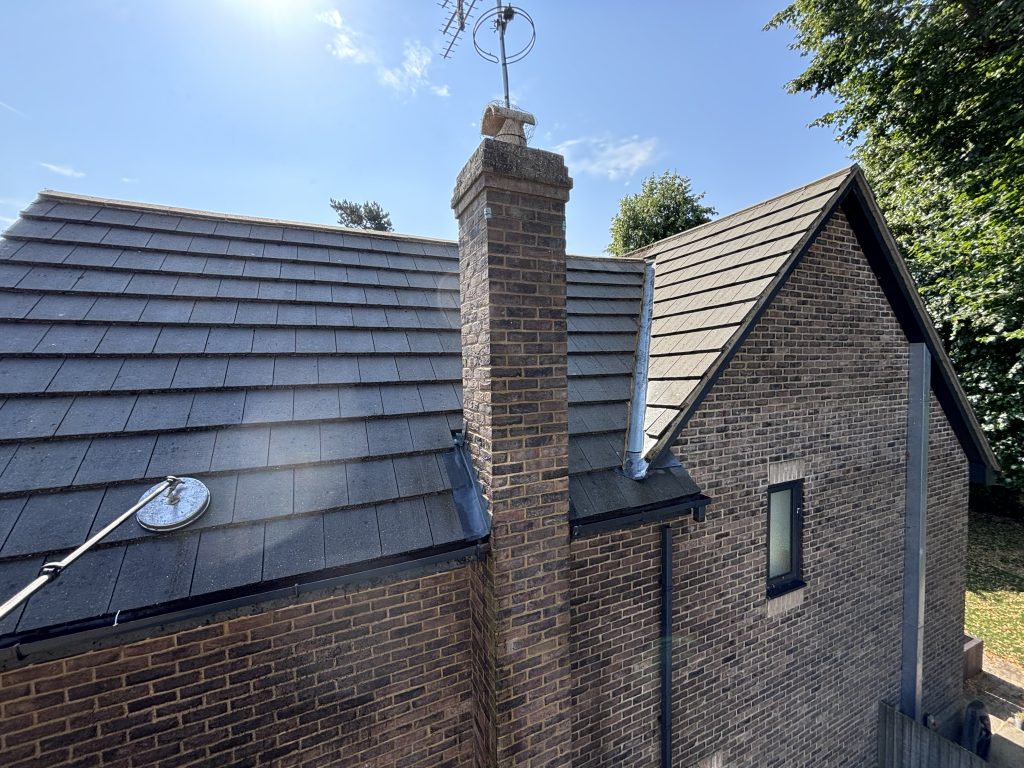
At Northants Exterior Cleaning, one of the systems we use on suitable roofs is a professional 12-inch rotary surface cleaner.
This equipment is different from a conventional single-nozzle pressure-washing lance.
Inside the cleaning head are two fan-jet nozzles mounted on a rotating spray bar.
As water passes through the system, the spray bar rotates, allowing the jets to clean a consistent area beneath the housing.
The nozzles are recessed within the cleaning head, creating a gap between the rotating jets and the roof tiles.
This arrangement influences the spray pattern and working distance, although it does not eliminate the possibility of surface damage.
Moderate pressure and higher water volume
Our cleaning machines are fully adjustable.
Rather than relying on maximum machine pressure, we generally use moderate pressure combined with a higher volume of water to remove and rinse moss and accumulated dirt from suitable roof tiles.
Water flow is particularly useful for carrying loosened debris away from the cleaning area.
The pressure and flow must be appropriate for the roof, and the rotating nozzles still need to be used carefully.
Why use a rotary cleaning head?
A rotary surface cleaner allows an area to be cleaned progressively using a rotating spray pattern.
It also offers a different working arrangement from repeatedly directing a concentrated lance jet at individual tiles.
However, rotary cleaning is not automatically gentler than other methods.
The pressure, nozzle specification, distance from the surface and condition of the tiles determine whether it is appropriate.
For that reason, we assess the roof before deciding whether to use rotary cleaning, manual removal or another suitable method.
Why Do We Clean From the Top of the Roof Downwards?
When using our water-cleaning equipment, we generally work from the ridge down towards the gutters.
There are practical reasons for this.
Working from the top down allows us to clean progressively without repeatedly passing over sections that have already been completed.
It also allows loosened moss, dirt and water to move down the roof towards the drainage areas.
This is consistent with Wienerberger’s advice that, where low-pressure washing is undertaken, water should be directed down the roof rather than upwards beneath the tile overlaps.
Working from the ridge down does not eliminate every risk of water ingress.
The spray direction, water pressure and condition of the tiles must still be considered.
Why Do We Use Scaffold Towers Instead of Walking on Roof Tiles?
Walking directly on roof tiles can cause damage.
Even where tiles appear strong, concentrated foot pressure may cause cracking or disturb individual tiles.
Older roof coverings can be particularly vulnerable.
At Northants Exterior Cleaning, our cleaning methods are designed around working from suitable access equipment, including scaffold towers, without walking directly on the roof tiles.
We use specialist telescopic poles to operate our cleaning equipment from these access positions.
Some of our pole systems can extend to considerable lengths, making equipment balance and handling important considerations.
With our rotary cleaning system, the reaction force generated by the water jets can help support the cleaning head at the end of the pole.
This reduces some of the physical effort involved in operating long equipment.
It does not replace the need for proper access arrangements, controlled handling or an assessment of the forces involved.
Our aim is to complete the work without unnecessary foot traffic on the roof covering.
Is Manual Roof Scraping a Better Alternative?
Manual moss removal is another method we use where appropriate.
It involves carefully removing established moss using suitable hand tools.
One advantage is that individual areas of growth can be addressed without applying large volumes of water.
However, scraping is not automatically harmless.
Aggressive scraping or unsuitable tools can damage tile surfaces, especially where tiles are fragile or heavily weathered.
Some manufacturers discourage mechanical removal for particular products.
The choice between manual removal and controlled water cleaning should therefore depend on the tile type, roof condition and manufacturer’s recommendations.
There is no single cleaning method that is ideal for every roof.
What Happens to the Moss and Debris During Cleaning?
Removing moss from the tiles is only part of the job.
If large quantities of moss are allowed to enter gutters and downpipes, they can create blockages.
Before cleaning, we take precautions to protect surrounding areas and manage the debris produced.
Where appropriate, downpipes are disconnected to prevent moss and other material entering the drainage system.
We also protect vulnerable plants and nearby surfaces.
Following cleaning, gutters are vacuumed and flushed, and disconnected downpipes are reconnected.
This is particularly important because a roof may look clean while the gutters remain full of loosened moss.
What Is a Roof Biocide Treatment?
A biocide is a treatment designed to control particular biological organisms.
Depending on the product and its authorised uses, roof treatments may be used to control algae, moss or other biological growth.
Following suitable roof cleaning, we can apply an appropriate biocide treatment using a brush-based application system.
The purpose is to help control remaining growth and inhibit future regrowth.
However, a biocide is not a permanent solution.
The roof will remain exposed to moisture, airborne spores, shade and environmental conditions that can encourage biological growth.
Any treatment must be suitable for the roofing material, used according to its label and applied with appropriate precautions to protect people, plants, animals and drainage systems.
Will Moss Grow Back After Roof Cleaning?
Eventually, it can.
Even a thoroughly cleaned roof remains exposed to the conditions that originally encouraged moss growth.
North-facing roof slopes, nearby trees and persistently damp conditions may encourage faster regrowth than sunny, exposed areas.
A suitable biocide treatment can help delay this process, but it cannot permanently change the roof’s environment.
Homeowners should be cautious about claims that a roof will never develop moss again.
Can Roof Cleaning Cause Leaks?
Yes, if unsuitable methods are used or existing defects are disturbed.
High-pressure water directed beneath tile overlaps can potentially enter the roof structure.
Fragile or damaged tiles may also be vulnerable to further damage during cleaning.
This is why the roof should be assessed before work begins.
Where tiles are loose, cracked or severely deteriorated, repairs or specialist roofing advice may be more appropriate than cleaning.
A professional roof clean should never be treated as a substitute for necessary roof repairs.
Does a Roof Need Repainting After Cleaning?
Not necessarily.
Some roof-cleaning companies offer additional coatings or roof-painting systems.
However, cleaning an older concrete roof does not automatically mean it needs to be repainted.
The NFRC has raised concerns about unsupported claims that roof painting extends roof life or improves thermal performance.
Applying additional coatings can also create problems if unsuitable products interfere with tile drainage channels or overlaps.
Any proposed coating should be assessed against the roofing manufacturer’s guidance and supported by credible evidence.
A clean roof does not automatically require a new painted finish.
How Often Should a Roof Be Cleaned?
There is no universal cleaning interval.
A roof surrounded by trees may develop heavy moss much more quickly than one exposed to regular sunlight.
The best approach is to monitor the condition of the roof and its drainage system.
Signs that an assessment may be worthwhile include:
- Heavy moss accumulating around tile joints.
- Repeated gutter blockages caused by falling moss.
- Moss obstructing roof valleys or drainage channels.
- Extensive growth concealing the condition of the roof.
- Visible deterioration requiring further investigation.
Light moss growth without drainage problems may not require cleaning at all.
How Should Homeowners Choose a Roof-Cleaning Company?
Before arranging roof cleaning, it is worth asking a few practical questions.
What type of tiles are installed, and has their condition been assessed?
Which cleaning method is proposed, and why?
Will the contractor use high-pressure jets, controlled low-pressure equipment, manual removal or chemical treatment?
How will the roof be accessed?
Will anyone need to walk directly on the tiles?
What precautions will be taken to protect gutters, downpipes, plants and surrounding areas?
And what happens if damaged or fragile tiles are discovered?
A reputable contractor should be able to explain the proposed method clearly, acknowledge its limitations and recommend an alternative where cleaning is unsuitable.
The Bottom Line: Roof Cleaning Should Be About Understanding the Roof
Moss growth is a natural occurrence, and not every roof needs cleaning.
Some concrete roof tiles have factory-applied finishes that weather over time. Moss can establish on weathered surfaces, but its presence does not automatically indicate a defective roof.
High-pressure jet washing can damage roof tiles, and manufacturer warnings about this should be taken seriously.
However, professional water-cleaning equipment can operate at different pressures and flow rates. The actual method, equipment configuration, tile condition and application technique all matter.
At Northants Exterior Cleaning, we use a range of methods, including manual moss removal, controlled water cleaning and suitable biocide treatments.
Our approach is to assess the roof, select an appropriate method, work from suitable access equipment and avoid unnecessary foot traffic on the tiles.
Ultimately, the most important question isn’t simply whether a roof is being pressure washed. It’s whether the proposed cleaning method is appropriate for that particular roof.
Northants Exterior Cleaning is a small, locally based exterior-cleaning business serving Rushden, Northampton, Wellingborough, Kettering and surrounding Northamptonshire areas. For more information about our working methods, visit our roof-cleaning service page.